Posts

Showing posts with the label Manual Testing

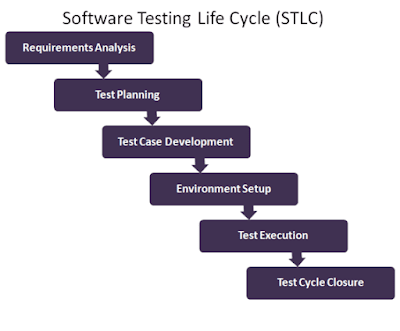
What is Software Testing Life Cycle (STLC)?
Image
Just like developers follow the  Software Development Life Cycle (SDLC)  likewise testers also follow the  Software Testing Life Cycle  which is called as  STLC . It is the sequence of activities carried out by the  testing team  from the beginning of the project till the end of the project. Software Testing Life Cycle is a testing process which is executed in a  sequence, in order to meet the quality goals. It is not a single activity but it consists of many different activities which are executed to achieve a good quality product. There are different phases in STLC which are given below: Requirement analysis Test Planning Test case development Environment Setup Test Execution Test Cycle Closure Each of the step mentioned above has some Entry Criteria (it is a minimum set of conditions that should be met before starting the software testing) as well as Exit Criteria (it is a minimum set of conditions that should be completed in ord...
What is the Software Development Life Cycle (SDLC)?

What are the Software Development Life Cycle (SDLC) phases? There are various software development approaches defined and designed which are used/employed during development process of software, these approaches are also referred as “Software Development Process Models” (e.g.  Waterfall model ,  Incremental model ,  V-model ,  Iterative model ,  RAD model ,  Agile model ,  Spiral model ,  Prototype model  etc.). Each process model follows a particular life cycle in order to ensure success in process of software development. Software life cycle models describe phases of the software cycle and the order in which those phases are executed. Each phase produces deliverables required by the next phase in the life cycle. Requirements are translated into design. Code is produced according to the design which is called development phase. After coding and development the testing verifies the deliverable of the implementation phase agai...

What is Dynamic Testing?

What is Dynamic testing technique? This testing technique needs computer for testing. It is done during Validation process. The software is tested by executing it on computer. Example of this  Dynamic Testing Technique :  Unit testing ,  integration testing ,  system testing .

What is Static Testing?

Static testing is the testing of the software work products manually, or with a set of tools, but they are  not executed . It starts early in the Life cycle and so it is done during the verification process. It does not need computer as the testing of program is done without executing the program. For example:  reviewing, walk through, inspection, etc.

What is Beta testing?

Beta Testing  is also known as field testing. It takes place at  customer’s site . It sends the system/software to users who install it and use it under real-world working conditions. A beta test is the second phase of  software testing  in which a sampling of the intended audience tries the product out. (Beta is the second letter of the Greek alphabet.) Originally, the term  alpha testing  meant the first phase of testing in a software development process. The first phase includes  unit testing ,  component testing , and  system testing . Beta testing can be considered “pre-release testing. The goal of beta testing is to place your application in the hands of real users outside of your own engineering team to discover any flaws or issues from the user’s perspective that you would not want to have in your final, released version of the application. Example: Microsoft and many other organizations release beta versions of their products...

What is Component testing?

Image
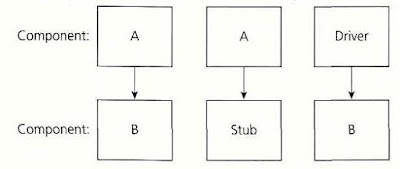
What is Component testing? :   Component testing is a method where testing of each component in an application is done separately.  Suppose, in an application there are 5 components. Testing of each 5 components separately and efficiently is called as component testing. Component testing is also known as module and program testing. It finds the defects in the module and verifies the functioning of software. Component testing is done by the tester. Component testing may be done in isolation from rest of the system depending on the development life cycle model chosen for that particular application. In such case the missing software is replaced by  Stubs  and  Drivers  and simulate the interface between the software components in a simple manner. Let’s take an example to understand it in a better way.   Suppose there is an application consisting of three modules say, module A, module B and module C. The developer has developed the module B and now ...

What is Alpha testing?

Alpha testing is one of the most common  software testing   strategy  used in software development. Its specially used by product development organizations. This  test takes place at the developer’s site . Developers observe the users and note problems. Alpha testing is testing of an application when development is about to complete. Minor design changes can still be made as a result of alpha testing. Alpha testing is typically performed by a group that is independent of the design team, but still within the company, e.g. in-house software test engineers, or software QA engineers. Alpha testing is final testing before the software is released to the general public. It has two phases: In the  first phase  of alpha testing, the software is tested by in-house developers. They use either debugger software, or hardware-assisted debuggers. The goal is to catch bugs quickly. In the  second phase  of alpha testing, the software is handed over to t...

What is System Testing?

In  system testing  the behavior of whole system/product is tested as defined by the scope of the development project or product. It may include tests based on risks and/or requirement specifications, business process, use cases, or other high level descriptions of system behavior, interactions with the operating systems, and system resources. System testing is most often the final test to verify that the system to be delivered meets the specification and its purpose. System testing is carried out by specialists testers or independent testers. System testing should investigate both  functional  and  non-functional requirements  of the testing.

What is Functionality Testing?

Functionality testing  is performed to verify that a software application performs and functions correctly according to design specifications. During functionality testing we check the core application functions, text input, menu functions and installation and setup on localized machines, etc. The following is needed to be checked during the functionality testing: Installation and setup on localized machines running localized operating systems and local code pages. Text input, including the use of extended characters or non-Latin scripts. Core application functions. String handling, text, and data, especially when interfacing with non-Unicode applications or modules. Regional settings defaults. Text handling (such as copying, pasting, and editing) of extended characters, special fonts, and non-Latin scripts. Accurate hot-key shortcuts without any duplication. Functionality testing verifies that an application is still fully functional after localization. Even...